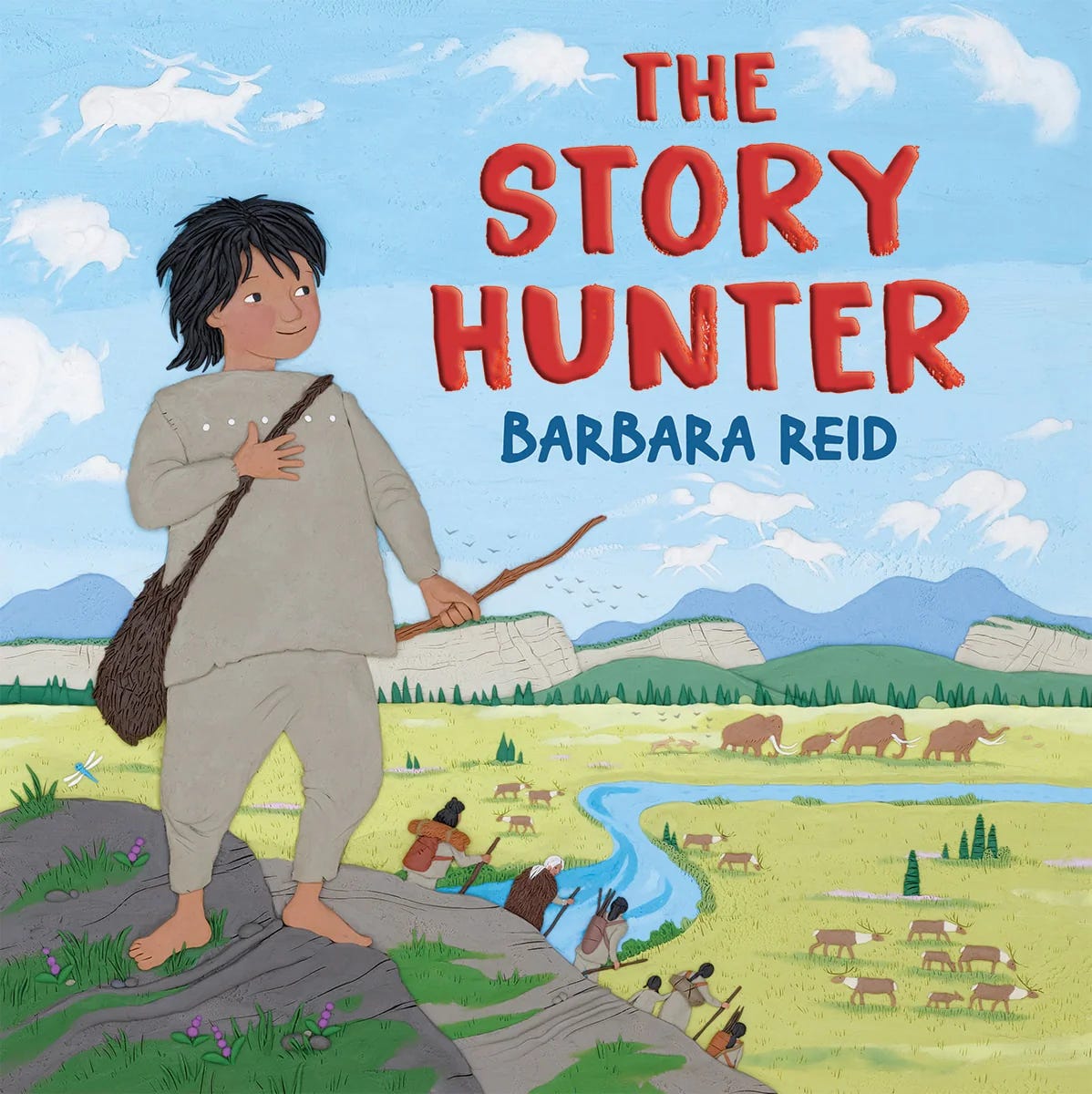
“We share our home with many families. Plants, fish, animals. And mammoths!”
A young boy from the Upper Paleolithic period invites us on a hunt — not for animals, but for stories that can only be told deep inside the earth: prehistoric cave paintings.
As we go deeper and deeper into the cave, the journey, told through simple, declarative statements, becomes increasingly perilous. The boy’s family hauls ground-up minerals (red iron oxide, yellow ocher, and charcoal) into a pitch-black cave, squeezing into hard-to-reach chambers guided only by stone lamps fueled with animal fat and wood torches that consume precious oxygen.
And it would be so easy to get lost!
There, they paint magnificent murals of the deer, mammoths, and bison they hunt.
Author/illustrator Barbara Reid was clearly inspired when she viewed their work, up to 22,000 years later. Their method of creation was ingenious, producing a cinematic animation effect in a cavernous theatre deep within the earth. They deliberately painted animals with extra legs, heads, or tails on naturally bumpy, uneven cave walls so that when flickering lamps or torches cast moving shadows across the rock, the animals appeared to run. This trick of the eye, called pareidolia, causes humans to see dancing animals in ambiguous shapes and shadows.
So, that was how they created art deep within a cave. But The Story Hunter raises an even more profound question: Why create art at all?
One answer lies in how the boy and his family stencil their signatures by blowing pigments through hollowed bird bones and reeds around their hands pressed against the cave walls. Artists, then and now, create for the same reasons: to make sense of how we fit into our world; to show gratitude for what the earth provides; to record what we see; to connect with others past, present, and future; to better understand who we are, how we feel, what we think; and, to simply say, “I was here.”
All of the illustrations for The Story Hunter were created using Reid’s signature modelling clay and acrylic paint style, resulting in highly detailed three-dimensional images. The magical realism of the animals in the caves is echoed in the clouds above the hunting grounds. Vast grasslands grace the endpapers. The two-page scenes inside the tent at daybreak, as well as the cave mural featuring the family dancing, are especially otherworldly. The strength of The Story Hunter is in the art.
This picture book is best suited for aspiring young artists (ages 3–8) whose preferred medium is finger paint to create their own murals.
Barbara Reid’s career spans more than a dozen picture books, including Picture the Sky, The Subway Mouse, and The Party. Her books have been translated into at least nine languages. In 2013, she was made a Member of the Order of Canada for her contributions to Canadian children’s literature. As a child, she loved the outdoors, reading, drawing, writing, and fooling around with Plasticine (a type of modelling clay). She lives in Toronto with her husband, a photographer who photographs her modelling-clay artwork for publication.
North Winds Press, 2026. ISBN 9781039710337XXX (hard cover).
Reviewer: Jessica Scott Kerrin is a best-selling Canadian children’s author who has served on the Governor General’s Literary Awards, numerous provincial writing juries and mentorships, and leads writing workshops for literary organizations: jessicascottkerrin.com.